Allows Easy Interface Between a I2C Microport and a 1-Wire Slave
I2C Host Interface Supports 100kHz and 400kHz I2C Communication Speeds
1-Wire Master IO with Selectable Active or Passive 1-Wire Pullup
Provides Reset/Presence, 8-Bit, Single-Bit, and 3-Bit 1-Wire IO Sequences
Standard and Overdrive 1-Wire Communication Speeds
One Address Inputs for I2C Address Assignment
Minimizes Line Noise Reducing System EMI
Slew-Controlled 1-Wire Edges
Supports EEPROMs, Temperature Sensors, or other 1-Wire Slaves That Have Momentary High Source Current Modes
Strong 1-Wire Pullup Provided by an Internal Low-Impedance Signal Path
PCTLZ Output to Optionally Control an External MOSFET for Stronger Pullup Requirements
Reduce Power Consumption Saves on Power Supply Cost
Supports Power-Saving Sleep Mode
Operating Range: 2.9V to 5.5V, -40°C to +85°C
9-Bump WLP Package
DS2482-101 Applications
Cell Phones/PDAs
Industrial Sensors
Medical Instruments
Printers
DS2482-101 Description
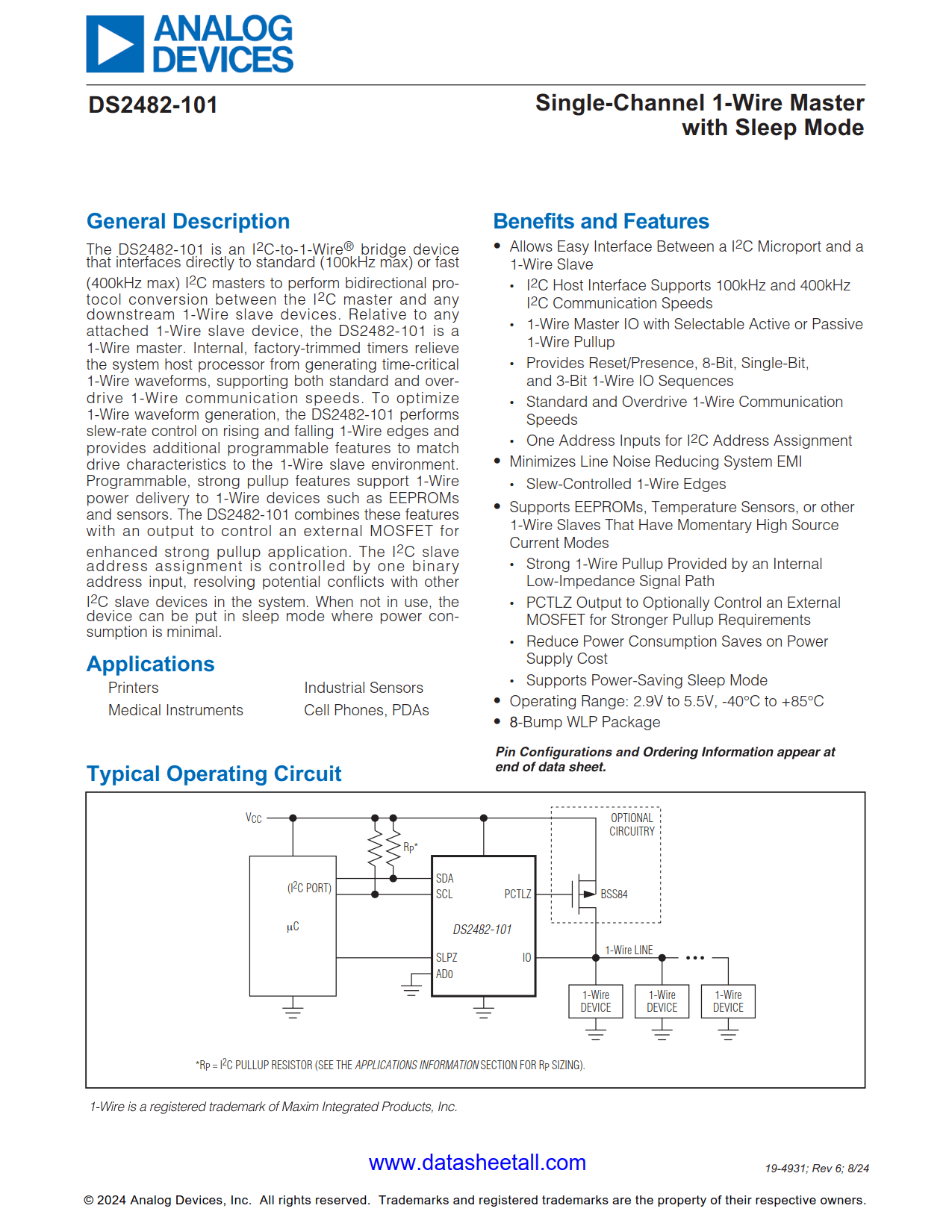
The DS2482-101 is an I2C-to-1-Wire bridge device that interfaces directly to standard (100kHz max) or fast (400kHz max) I2C masters to perform bidirectional protocol conversion between the I2C master and any downstream 1-Wire slave devices. Relative to any attached 1-Wire slave device, the DS2482-101 is a 1-Wire master. Internal, factory-trimmed timers relieve the system host processor from generating time-critical 1-Wire waveforms, supporting both standard and overdrive 1-Wire communication speeds. To optimize 1-Wire waveform generation, the DS2482-101 performs slew-rate control on rising and falling 1-Wire edges and provides additional programmable features to match drive characteristics to the 1-Wire slave environment. Programmable, strong pullup features support 1-Wire power delivery to 1-Wire devices such as EEPROMs and sensors. The DS2482-101 combines these features with an output to control an external MOSFET for enhanced strong pullup application. The I2C slave address assignment is controlled by one binary address input, resolving potential conflicts with other I2C slave devices in the system. When not in use, the device can be put in sleep mode where power consumption is minimal.