
AD7999 Datasheet
4-Channel, 8-Bit ADC with I2C Compatible Interface in 8-Lead SOT-23
4-Channel, 8-Bit ADC with I2C Compatible Interface in 8-Lead SOT-23
| Part No. | In Stock | Price | Packaging | SPQ | Marking | MSL | Pins | Temp Range | Package Description |
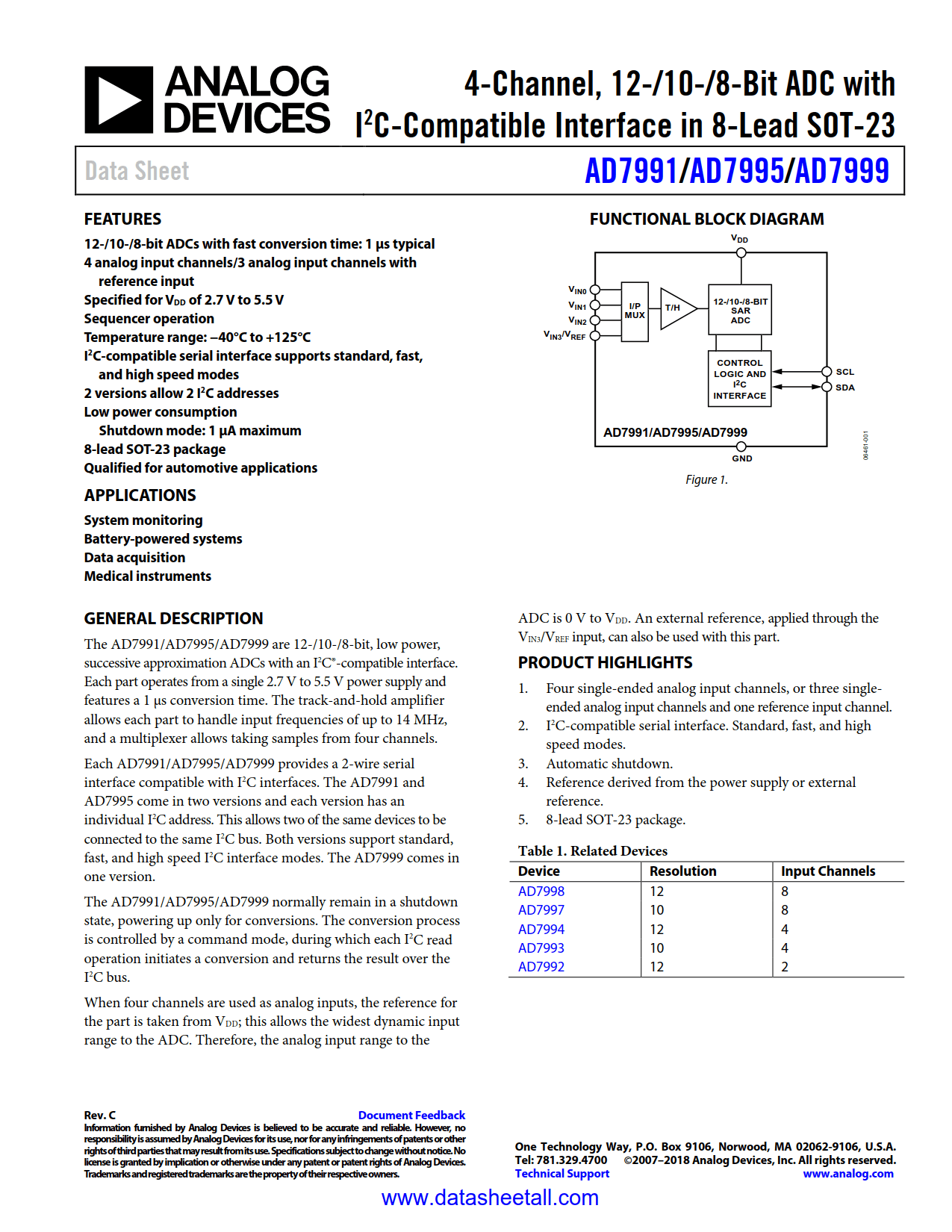
The AD7999 are 8-bit, low power, successive approximation ADCs with an I2C®-compatible interface. Each part operates from a single 2.7 V to 5.5 V power supply and features a 1 μs conversion time. The track-and-hold amplifier allows each part to handle input frequencies of up to 14 MHz, and a multiplexer allows taking samples from four channels.
Each AD7999 provides a 2-wire serial interface compatible with I2C interfaces. The AD7999 comes in one version.
The AD7999 normally remain in a shutdown state, powering up only for conversions. The conversion process is controlled by a command mode, during which each I2C read operation initiates a conversion and returns the result over the I2C bus.
When four channels are used as analog inputs, the reference for the part is taken from VDD; this allows the widest dynamic input range to the ADC. Therefore, the analog input range to the ADC is 0 V to VDD;. An external reference, applied through the VIN3/VREF input, can also be used with this part.